Loading…
ERPNext implementation for manufacturers across India
ERPNext, set up around how your plant already runs.
Stores, production, quality and dispatch in one system. Stock numbers match, nobody chases a batch on WhatsApp, and every department sees the same figures.
- Built on ERPNext: you own the system, no per-user licence
- Configured to how your plant already runs, not a generic template
- Existing stock, party and transaction data migrated
Problems most plants call us about.
If two or more of these sound like your plant, ERPNext will help.
Stock numbers stop matching
The register says one thing, the sheet says another, and the floor says a third. Someone has to physically go and count before a decision can be made.
Production status lives on WhatsApp
“Batch B17 update?” “Please confirm RM-204 count.” Information moves by message, so it is only as current as the last person who replied.
Every department keeps its own file
Purchase, stores, production and accounts each maintain a version. When the numbers disagree, nobody can say which one is right.
Month-end reports take days
Someone rebuilds the month from four different files, when the figures should already be in one place.
One entry. Every department sees it.
Receive material, build pumps and dispatch an order. Stores, production, quality and accounts all read the same record, so nobody has to ask on WhatsApp.
Try it: a pump plant on ERPNext
Sample data. Each action updates every department.
Stores
120
impellers in stock
Production
8
pumps ready to ship
Quality
46/47
checks passed today
Accounts
₹12,40,000
invoiced this week
Activity
- Shift A started on line 2
From sales order to payment, on one record.
Each department works in its own screen, and every document is created from the one before it. Pick a step to see the screen.
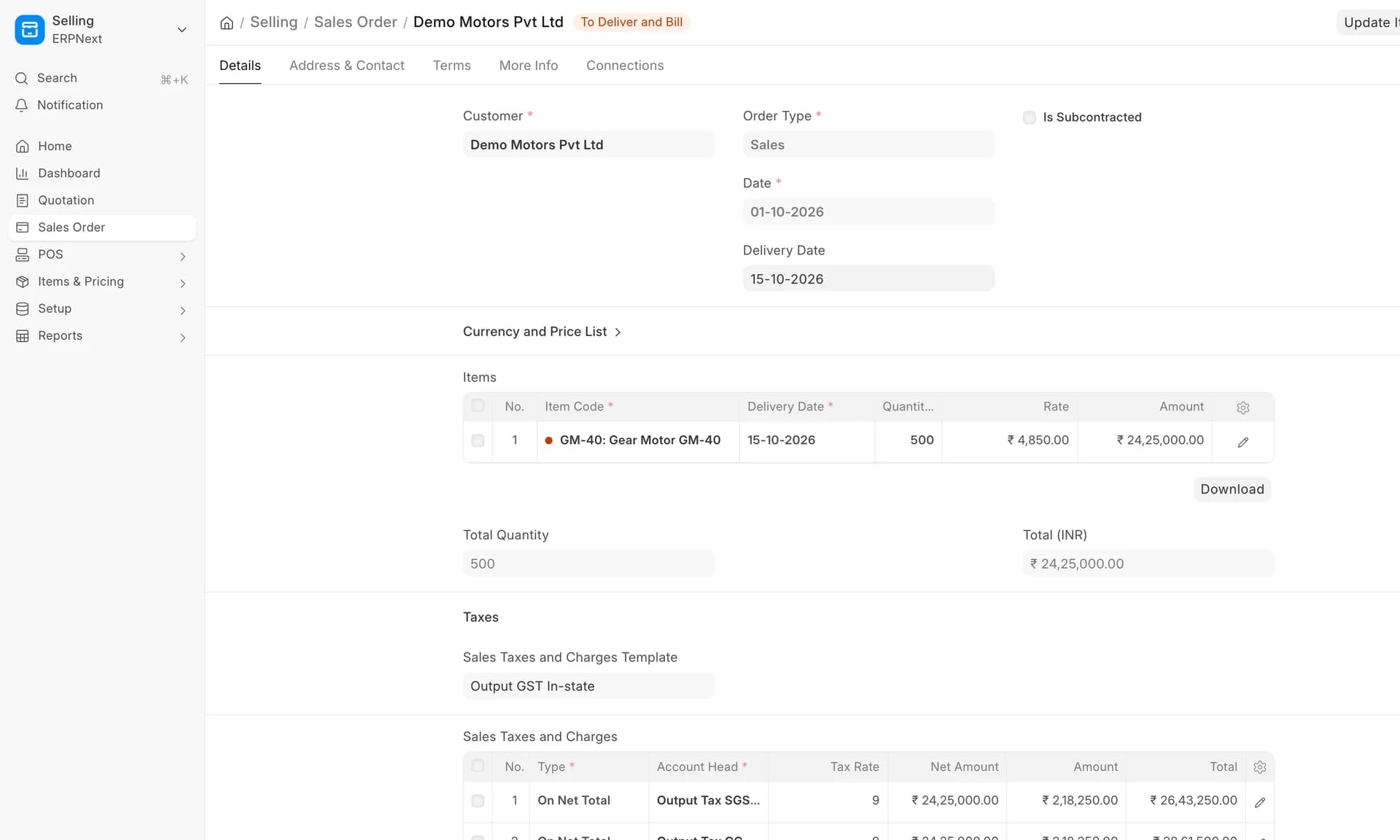
1. Sales order, done by the sales team
The customer's order goes in once, with GST taxes, delivery date and items. Everything after it is created from this order.
Screens from an ERPNext demo company, not a client system.
What a typical implementation covers.
- Real-time stock across stores, WIP and finished goods
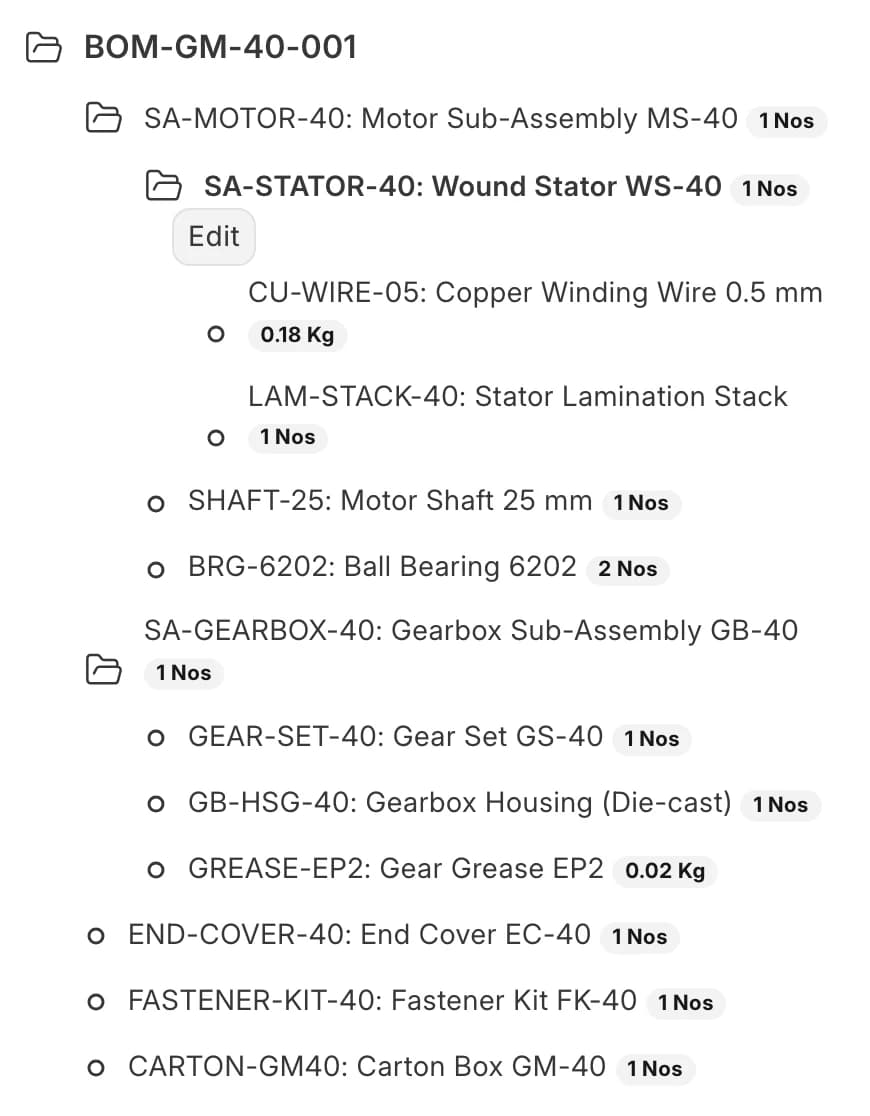
- Multi-level BOM with routing and work orders
- Job cards and shop-floor production tracking
- Purchase requisition to GRN to payment
- Incoming and in-process quality inspection
- Batch and serial traceability
- Subcontracting and job-work flows
- Dispatch, delivery notes and e-way bills
- GST-ready invoicing and accounting
- Role-based access for every department
- Barcode and scanner-driven transactions
- Migration of existing masters and balances
Where ERPNext does not fit, we extend it.
Workflows, forms, print formats, approvals and reports are configured to your process. Real gaps are closed with custom apps on the Frappe framework, so you are not asked to change how you run the plant to suit the software.
Four steps, starting on your floor.
- 1Process walkthroughWe sit with your production, stores, purchase and accounts people and map how work actually moves today, including the parts that live outside any system.
- 2ConfigurationBOMs, workflows, approvals, document formats and user roles built around your process. Where ERPNext does not fit, we extend it rather than ask you to change.
- 3Migration and trainingItem masters, parties, stock balances and open transactions brought across. Staff trained by role, on their own data, before anything is switched over.
- 4Go-live and supportCutover with us present, then ongoing support as your processes, products and reporting needs change.
Plants anywhere in India
Distance doesn't change how we work: the parts that need us there happen in person.
- On your floorThe process walkthrough, training and go-live happen at your plant.
- On call every dayQuestions, changes and support by phone, WhatsApp and online sessions.
What manufacturers ask first.
Something else on your mind? Call us on +91 95882 75727; you will talk to the person who would run your implementation.
That is the most common reason people call us. Implementations usually fail for one of three reasons: the software could not do what the business needed, the requirement was never mapped properly, or the staff found it slower than what they were doing before. We start with the process walkthrough for exactly that reason, and we train by role on your own data rather than on a demo company. If your requirement is something ERPNext genuinely cannot do, we will tell you at the walkthrough rather than after the invoice.
Only if it is faster than what they do now. That is a design question, not a training question. Data entry is kept to the screens each role actually needs, barcode and scanner input replaces typing where it can, and approvals go where the work already goes. Training is by role, on your own data.
It depends on how many processes are in scope, how many locations, and how much historical data moves. We give you a timeline after the process walkthrough, not before. A number quoted before anyone has seen your plant is a guess.
Yes, and that is the point. ERPNext is open source, so workflows, forms, print formats, approvals and reports are configured to your process, and genuine gaps are closed with custom apps on the Frappe framework. You are not asked to change how you run the business to suit the software.
Item masters, customers, suppliers, stock balances and open transactions are migrated so you start with your real numbers rather than an empty system. What can and cannot come across is confirmed during the walkthrough.
It depends on scope, number of users, locations and how much migration and customisation is involved. ERPNext itself is open source, so there is no per-user vendor licence. You own what we build. Tell us about your operation and we will send a specific number.
Tell us how your plant runs today.
We will map your process on the floor and tell you plainly what ERPNext would change, and what it would not.